Quick Answer: The documents to keep in your vehicle are your current registration, proof of insurance, a short list of emergency contacts, and your basic maintenance records, while your driver’s license, car title, and passport should stay with you or at home instead.
Key Takeaways
- Registration and proof of insurance are legally required in every state, and most drivers keep both in the glove box.
- Your driver’s license should stay on your person, not in the car, since it doubles as your primary ID.
- Car titles and passports belong at home in a safe place, not in the vehicle, to limit identity theft risk.
- A short emergency contact card and a copy of your roadside assistance or vehicle service contract number can save time during a breakdown.
- A basic maintenance log helps with resale value, warranty claims, and any vehicle service protection claim you may need to file.
Car Document Checklist
Check off each item as you confirm it’s in your glove box
Legally required
Emergency and roadside
Maintenance and coverage
The Essential Documents to Keep In Your Car
States require drivers to carry current registration and proof of insurance. Registration proves you own the vehicle or have permission to drive it. Keep it current, since an expired sticker can still earn you a ticket, even if the car itself runs fine.
Proof of insurance works the same way. As of 2026, every state and Washington, D.C., now accept some form of digital insurance card on your phone during a traffic stop. A few states still handle it differently. Massachusetts, for example, lists insurance information on the registration document instead of issuing a separate card. A dead phone battery is not a valid excuse. Keep a printed backup of your insurance card in the glove box too.
Some states also require an emissions or safety inspection certificate. Check your state DMV site if you are not sure whether that applies to you.
Where Should You Store These Documents?
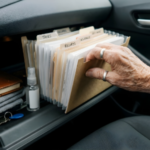
The glove box is the standard spot for registration and insurance, mainly because it is easy to reach during a traffic stop and hard to forget about. A dedicated document holder or a small folder keeps the two together so you are not digging through fast food napkins when an officer asks for them.
It also helps to take a photo or screenshot of both documents and save them to your phone. That way, if the paper copy ever goes missing, you still have something to show while you sort out a replacement. Just remember that a screenshot is a backup, not a substitute for keeping the physical or app-based version current.
Two Documents To Leave At Home, Not In The Car
Your car title and your passport are two of the few documents you should never leave in the vehicle. The title proves ownership, and losing it or having it stolen can turn a simple errand into a drawn out process at the DMV to replace it. Keep it in a fireproof box or a safe deposit box at home instead.
Your driver’s license and any passport should also stay with you rather than in the car. Both are primary identity documents, and leaving them behind in a parked vehicle gives a thief everything needed for identity theft, not just a set of keys.
What Emergency Information Should Ride Along In Your Glove Box?
A short card with emergency contacts, your insurance company’s claims number, and your roadside assistance number belongs in every glove box. If you are ever in an accident or your car breaks down somewhere without cell service, having those numbers on paper means you are not relying on a phone that might be damaged, dead, or out of signal range.
If anyone with a medical condition regularly rides in the car, a brief note about allergies or medications can help first responders act quickly. Families with adopted children or shared custody arrangements sometimes also keep a copy of guardianship paperwork in the car in case questions come up during an emergency.
Why Keep A Basic Maintenance Record With Your Car Documents?
A simple log of recent service, oil changes, tire rotations, and any repairs, gives you a quick reference when a mechanic asks about your car’s history. It also supports your case if you ever need to file a warranty or vehicle service protection claim, since providers often ask for proof that routine maintenance was kept up.
You do not need every receipt going back to the day you bought the car. A one-page summary or a note in your phone works fine for daily driving, while the full paper trail can stay at home. If you are trying to figure out what should be serviced next based on mileage, it helps to know when to service key systems as your car ages, since some fluids and parts have their own schedules separate from the oil change interval.
Extra Documents To Keep In Your Car For Warranty Or Vehicle Service Protection
If you have a vehicle service contract, keep the plan and claims information accessible, since you may need authorization before repairs begin. Many plans require a call for authorization before a repair shop starts work, so having that number on hand avoids a delay while you are already dealing with a breakdown. For a full walkthrough, see how vehicle service contract claims work step by step.
FAQs
Q: Should I keep my car title in the glove box? No. Keep your car title at home in a safe place. It proves ownership, and losing it or having it stolen creates unnecessary hassle at the DMV.
Q: What should I do if I lose my registration? Contact your state DMV to request a replacement. Most states allow you to reprint or reorder one online, and many will let you show a temporary digital confirmation in the meantime.
Q: Do I need to keep my owner’s manual in the car? It is not legally required but keeping it in the glove box or trunk is handy for understanding warning lights, fuse locations, and basic troubleshooting on the road.
Q: Do I need to keep vehicle service protection paperwork in my car? Not the full contract, but keeping a small card with the plan number and claims phone number handy can speed up authorization if you need a covered repair while away from home.
Q: How often should I check that my car documents are up to date? A quick check twice a year, such as when the seasons change, helps you catch an expired registration or outdated insurance card before it becomes a problem.
Next Steps
Once your paperwork is in order, a few related habits round out good vehicle ownership. Here is where to go next.
Get your car ready before a long drive with a summer car maintenance checklist for road trips.
Learn the car maintenance tips mechanis wish more drivers knew to keep small issues from becoming big repairs.
If your car is getting older, see what to know about keeping a car beyond the warranty.
Not sure if extra coverage makes sense for you? Review the signs it may be time to consider vehicle coverage.