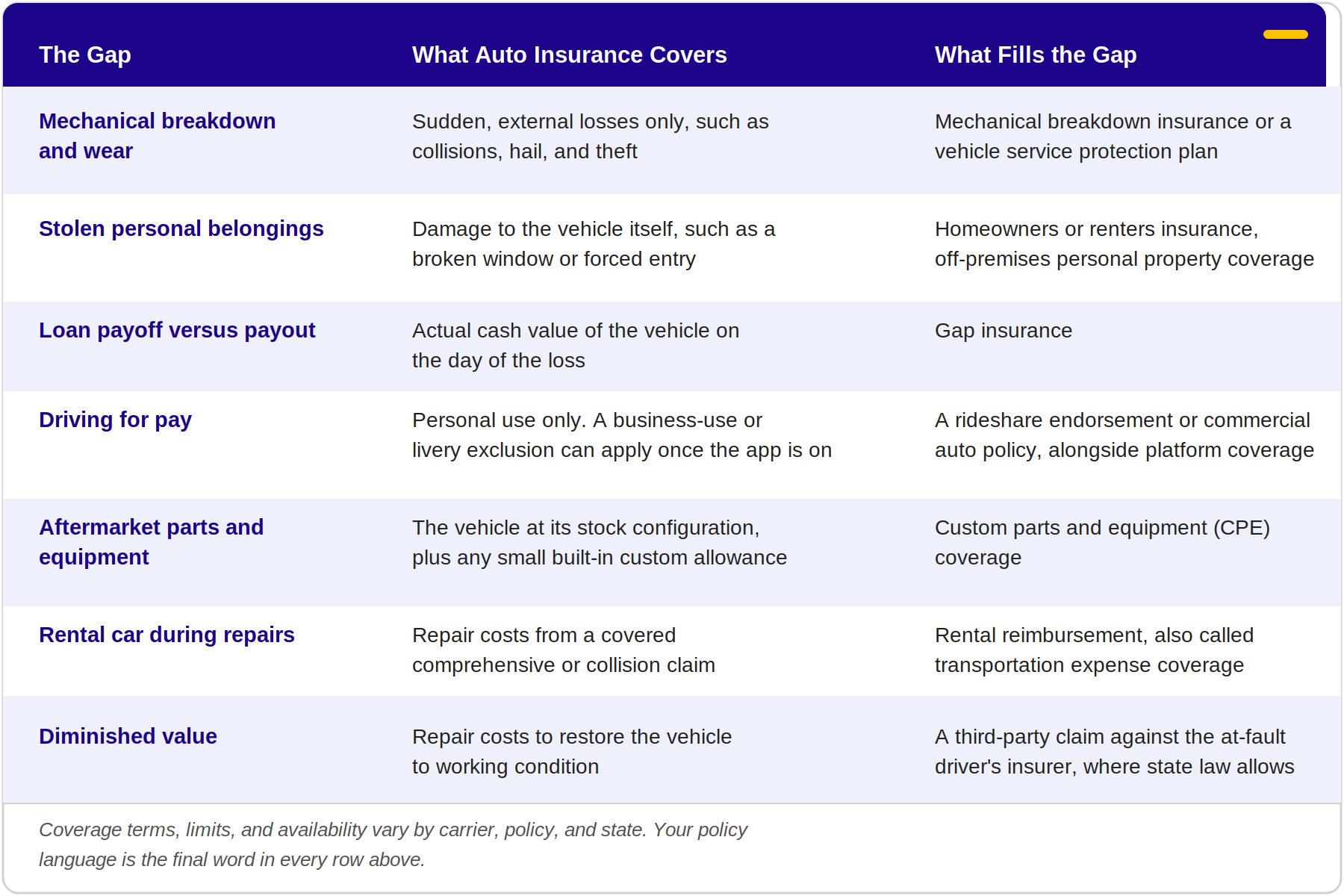
Quick answer: Auto insurance covers sudden, external events: crashes, theft, storms, vandalism. It skips normal wear, mechanical failure, and a handful of everyday situations drivers assume are included. Here are seven of the biggest gaps and what actually covers them.
Key Takeaways
- Auto insurance covers sudden losses like collisions and theft, and normally not mechanical breakdowns or normal wear and tear.
- Items stolen from your car are typically a homeowners or renters insurance claim, not an auto insurance claim.
- If your car is totaled, your insurer pays what it’s worth today, not what you still owe. Guaranteed Asset Protection Products (GAP) closes that difference.
- Turning on a rideshare or delivery app can pause your personal coverage the moment you go online, not just when a passenger is in the car.
- Aftermarket wheels, stereos, and lift kits need their own coverage, or you’ll recover only stock value.
- A rental car during repairs and lost resale value after an accident both usually require an add-on, or a claim against the at-fault driver.
1. Mechanical Breakdown Is the Big One Your Auto Insurance Won’t Cover
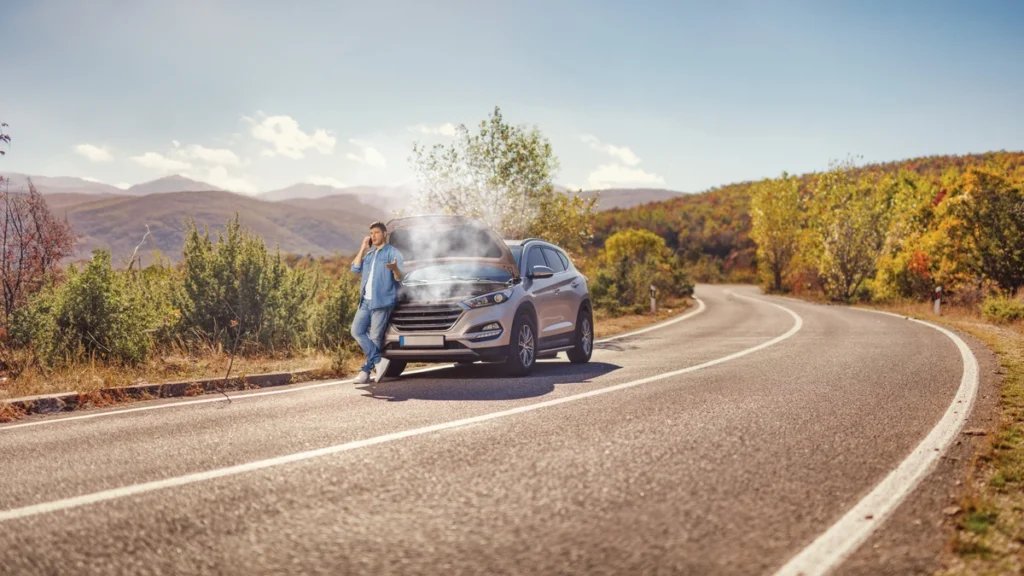
If your transmission fails or your engine seizes on a normal Tuesday commute, standard auto insurance likely won’t cover it. Comprehensive and collision step in for sudden, external events like crashes, hail, or theft. A part wearing out from age and mileage is neither, so insurers price the policy to exclude it.
That is also why insurers commonly exclude wear and tear items like brake pads, belts, filters, and tires across the board. Auto insurance, mechanical breakdown insurance, manufacturer warranties, and vehicle service contracts? Typically draw the same line, with routine maintenance and regular wear and tear items being the vehicle owner’s responsibility.
What covers it instead: mechanical breakdown insurance and vehicle service protection plans pick up major-system repairs after a factory warranty ends, exactly where auto insurance offers nothing. If you’re not sure whether that gap applies to you, these signs can help you think it through.
2. Personal Belongings Stolen From Your Car
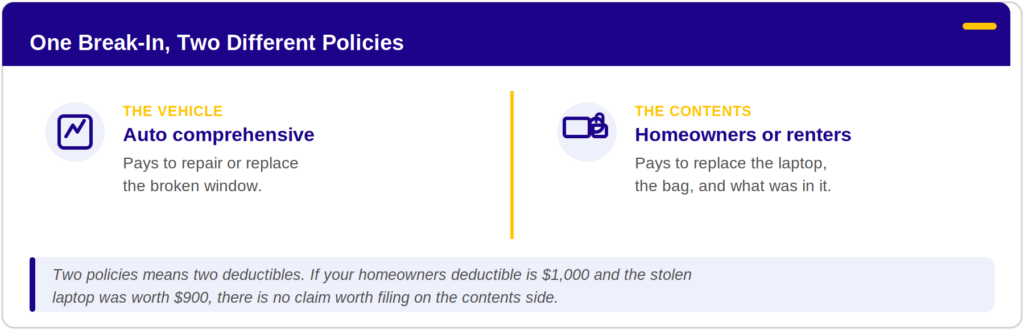
You come back to a smashed window and a missing laptop. Comprehensive coverage pays to repair the glass. It won’t pay for the laptop.
Personal belongings fall under homeowners or renters insurance instead, through off-premises personal property coverage. Two things narrow it in practice: your homeowners deductible applies, so a $1,000 deductible against a $900 laptop leaves nothing worth claiming, and categories like jewelry, cash, and electronics carry their own sub-limits that often sit below what the item is actually worth.
3. The Gap Between Your Loan Payoff and Your Insurance Payout
You total a car you’ve owned for 18 months. The insurer cuts a check for what the car was worth that morning. The lender or bank still wants what you still owe on the car, a larger number.
When a financed or leased car is totaled, your insurer pays actual cash value at the time of loss, factored for depreciation. Your loan balance doesn’t depreciate at the same pace. Early in a loan term, that mismatch can leave you owing thousands on a car you no longer have.
The gap is common enough that data tracks it: per Edmunds, close to 3 in 10 trade-ins in 2026 carried negative equity, averaging just under $6,900. Long loan terms make it worse, since early payments go mostly to interest.
GAP insurance can close that shortfall, but know its limits: it won’t pay off missed payments, rolled-over negative equity from a prior loan, or aftermarket modifications, and it only activates alongside an active comprehensive or collision claim.
What covers it instead: GAP Products, available through your lender, your insurer, or the dealership at purchase.
4. Driving for Pay Is Another Case Where Auto Insurance Won’t Cover You
Most personal auto policies carry a business-use or livery exclusion that applies the moment you go online, not only when a passenger is in the car.
What makes this confusing: coverage doesn’t switch on once and stay on. Regulators and platforms split the ride cycle into three periods, each with different protection.
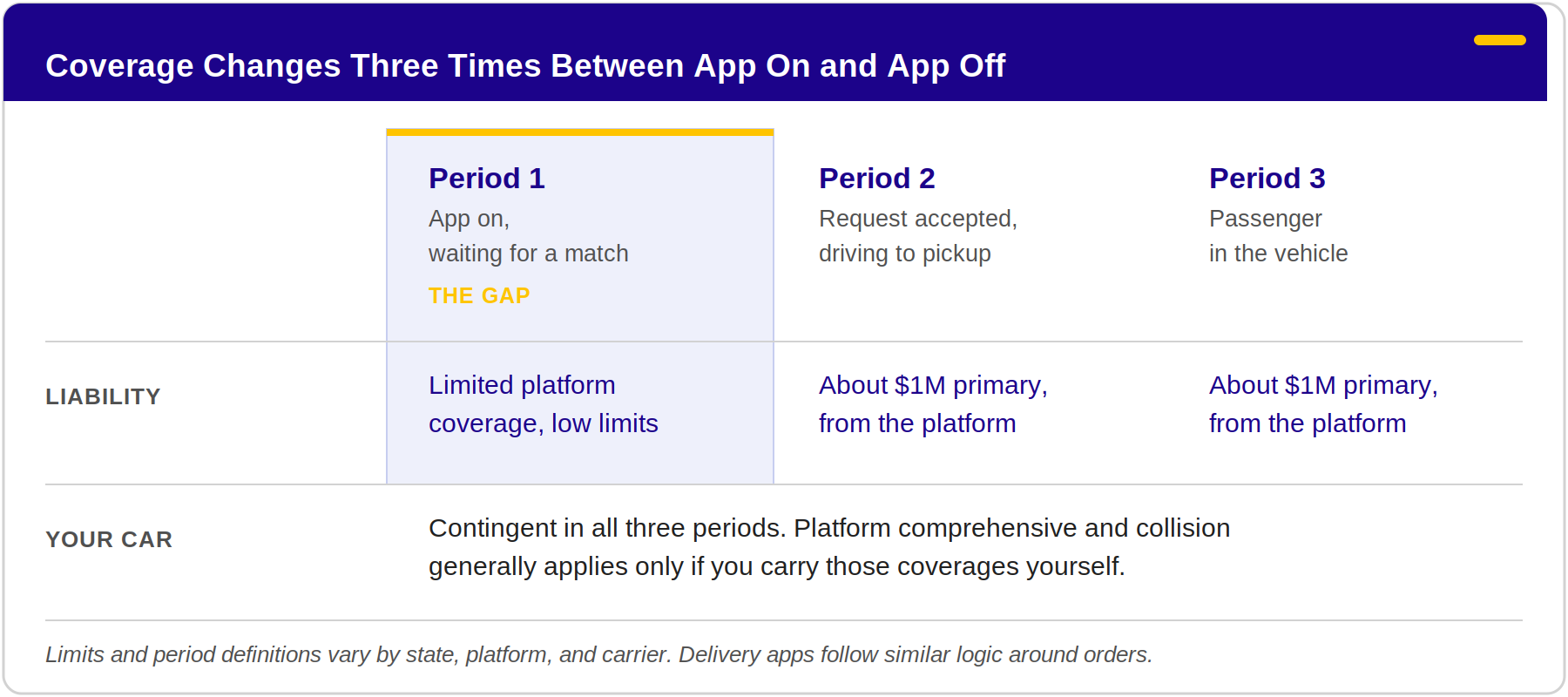
Across Periods 2 and 3, major platforms carry about $1 million in primary liability. Your own car is a separate question: platform comprehensive and collision coverage is usually contingent, meaning it only responds if you already carry that coverage yourself, and it often comes with a higher deductible than your own.
Delivery apps follow similar logic, but define the periods around accepting and completing an order rather than carrying a passenger.
What covers it instead: a rideshare endorsement added to your personal policy, or a separate commercial policy. Requirements and limits vary by state, so your policy language and your platform’s coverage terms decide it.
5. Aftermarket Parts and Custom Equipment
You put $4,000 into wheels and a stereo. The car gets totaled. The check reflects the current value of the car that left the factory.
Custom wheels, a lifted suspension, or an upgraded stereo add value, but standard comprehensive and collision coverage typically values the car at its stock configuration. Some policies include a modest built-in allowance for permanently installed custom equipment, and limits vary by carrier, so your policy language decides. Without enough allowance, a total loss or theft pays out at factory value, not what you actually put into it.
GAP Products carries the same limitation: it covers the vehicle’s value against a loan balance, not modifications layered on top.
What covers it instead: custom parts and equipment coverage, an endorsement widely abbreviated CPE, which raises the limit specifically for permanently installed upgrades. Typical limits run from roughly $2,000 to $10,000 depending on the carrier.
6. A Rental Car While Yours Is Out of Service
Your car sits in the shop for two weeks and you assume “full coverage” means a loaner. It usually doesn’t.
Full coverage, liability plus comprehensive and collision, doesn’t automatically include a rental car while yours gets repaired. That’s a separate, optional line, rental reimbursement or transportation expense coverage, and it typically activates only when a covered comprehensive or collision claim triggers the repair.
That last part matters: if your car is in the shop for a mechanical breakdown rather than an accident, rental reimbursement generally doesn’t apply either, since auto insurance doesn’t cover the underlying repair.
What covers it instead: rental reimbursement or transportation expense coverage added to your auto policy, which applies to accident repairs rather than breakdowns.
7. Diminished Value After a Repaired Accident
The repair is flawless. Two years later a dealer offers you less than you expected, because the vehicle history report shows the accident.
Even a perfect repair can leave a car worth less than its value before the crash, since buyers and appraisers weigh accident history when pricing a vehicle. Industry valuation data puts that loss at 10% to 25% of market value, so a $30,000 car can shed several thousand dollars on paper with nothing mechanically wrong. Insurers call that loss diminished value, and most won’t pay it out under your own policy if you were at fault.
A diminished value claim varies by state and sometimes has to go through the at-fault driver’s insurer instead. A handful of states don’t allow first-party diminished value claims at all, and insurers that do pay often cap the loss at 10% of pre-accident value before adjusting down for damage severity and mileage, which is why settlements frequently land below what the market actually took.
What covers it instead: a third-party claim against the at-fault driver’s insurer, usually supported by an independent appraisal. It’s a real cost, just not one your own comprehensive or collision coverage is designed to reimburse.
Frequently Asked Questions
Q: Does “full coverage” auto insurance cover everything? No. Full coverage means liability plus comprehensive and collision, covering crashes, theft, and weather damage. It skips mechanical breakdowns, routine maintenance, rental cars, and stolen personal items unless you add coverage for them.
Q: Am I covered while my rideshare app is on but I haven’t accepted a ride yet? That window is Period 1 in the table above, the thinnest part of the cycle. Your personal policy may exclude it under a business-use clause, and the platform usually offers only limited liability, well below the roughly $1 million that kicks in once you accept a request. A rideshare endorsement is the usual fix.
Q: Will my insurance pay for a rental car if my transmission fails? Typically not. Rental reimbursement only applies when a covered comprehensive or collision claim triggers the repair, and a mechanical failure isn’t one of those.
Q: Can I get a stolen laptop covered through my car insurance? Generally no. Personal belongings taken from your car fall under homeowners or renters insurance, through off-premises personal property coverage, not your auto policy, and your homeowners deductible applies.
Q: What actually covers a mechanical breakdown once my factory warranty ends? Mechanical breakdown insurance and vehicle service protection plans cover exactly this gap: major-system repairs like the engine, transmission, and electrical components after the manufacturer’s warranty runs out.
Next Steps
If these gaps leave you wondering how protected your car is against mechanical breakdowns, our self-assessment quiz can help you decide whether vehicle service protection makes sense for you.
Continued Reading
- What Does a Powertrain Warranty Cover?
- Vehicle Service Protection vs. Manufacturer’s Warranty: What’s the Difference?
- A Consumer’s Guide to Vehicle Service Contracts: Facts, Myths, and How to Buy Smart